Anthropic 上市在即,硅谷风投被迫“变大”以承接巨额融资
Anthropic 上市在即,硅谷风投被迫"变大"以承接巨额融资
Anthropic 的 IPO 前融资迫使风投机构扩大规模以开出巨额支票,同时 OpenAI 也在洽谈 300 亿美元的融资。资本需求的飙升与 LP 对 AI 投资的热情推高了 VC 巨型基金,但资本过度集中也面临着流动性回报及机构投资者依赖等潜在限制。
The Week In Short
Anthropic’s pre-IPO fundraising forced VCs to get bigger and the stakes could not be higher for its Wall Street debut. OpenAI is in talks for a $30 billion fundraise as a bridge to an IPO. SemiAnalysis was challenged on its data center build estimates, prompting a lively debate. A ranking of AI VCs from Stanford’s Ilya Strebulaev and Ohio State’s Blake Jackson puts a16z on top. AI lab Flapping Airplanes raises a $1 billion Series A and AI legal startup Legora raises a $550 million Series E. Bison Capital and Inspired Ventures raise new early-stage funds. The merger of Tesla and SpaceX inches closer. A PHP security freakout sweeps the Web. Meta beats estimates but worries investors. Polymarket’s Coplan hits a rough patch.
The Main Item

Does the big, well-known VC firm have enough money to do the deal?
That’s not a question that came up in Silicon Valley — until the AI revolution.
As we detailed yesterday in our tale about Anthropic’s fundraising, VCs including Menlo Ventures, Lightspeed, and ICONIQ effectively had to super-size themselves to be able to write the huge checks that Anthropic was seeking. They raised new funds, urged LPs to co-invest alongside them, and in some cases marketed special purpose vehicles widely to come up with the cash.
Anthropic’s S-1, expected any day, will show a cap table dominated by corporate investors and late-stage megafunds. A handful of smaller VCs hold more modest — albeit extraordinarily lucrative — stakes. We’ve written frequently about the growing power of a handful of Silicon Valley’s biggest firms, led by a16z and Sequoia, and Anthropic is something of a case study in the underlying forces driving that trend. Capital requirements have skyrocketed, alongside LP interest in going big on tech and AI.
OpenAI is poised to add another exclamation point on all this with a $30 billion fundraise at a $1.25 trillion valuation, according to a CNBC report Thursday.
Yet even as the rise of the VC megafunds reaches something of an apotheosis, there are reasons to think this capital concentration may have some limits.
Even assuming the Anthropic IPO goes well — if it doesn’t, all bets are off — there is a very large herd of unicorns out there that still has nowhere to go. The M&A business is reeling from high interest rates. Equity markets are receptive only to the best IPOs, and the AI-stock rout that hit late this week will close the window further.
A lot of LPs are sitting on big paper gains but haven’t gotten much cash back over the past decade, and thus don’t have the winnings to re-up into larger and larger funds indefinitely.
One potential weakness of the megafund model, in fact, is that it’s dependent on a fairly small pool of very large institutional investors, and sooner or later they are going to expect the kind of returns that only a small slice of venture funds have delivered in recent years. All the big firms were able to raise large new funds over the past year to go after AI, but it’s unclear how much more money there is behind that.
On the other side of the industry’s barbell, there is a growing cadre of investors who made a lot of money in earlier tech waves — or even in other fields — and can write checks much more sizeable than traditional seed or early-stage investors. Sound Ventures, along with Factorial Funds, started by a former Cruise Automation engineer, are poised to be major winners in Anthropic after putting $35 million and $50 million, respectively, into the Series C. They got the chance when the giants of Sand Hill Road took a pass.
That dynamic is evident with SpaceX too, where low-profile players like Valor Equity Partners scored huge windfalls.
It’s certainly true that the fracturing of the traditional venture model and the rise of the megafunds has made life tough for many mid-tier firms and emerging managers, who are often locked out of the best deals (or can get in only at inflated prices in the multiple-valuation rounds that are becoming increasingly common).
Yet the sheer scale of the AI investing opportunity means there’s still room for shrewd new players with fresh ideas. Another way to think about the megafunds is that they arise from the VC industry’s famously herd-like behavior: everyone wants to be in the deal everyone else is in.
The biggest opportunities, then, may lie in going against the grain. That game remains wide open.
CVAI

We’re three weeks out from the Cerebral Valley AI Summit, hosted in the heart of San Francisco on Nov. 12.
We’ve secured some of the top names in Silicon Valley to speak on our main stage, including Ali Ghodsi, Nikesh Arora, Igor Babuschkin, Lin Qiao, and Brendan Foody.
More speakers will be added to our lineup, so stay tuned.
Apply now to get a seat in the room.
Tweet Storm
Everyone is rushing to build data center capacity, but how much will actually come online is still uncertain — and some executives weren’t convinced by recent SemiAnalysis predictions.
SemiAnalysis researchers forecast 50GW of data center capacity coming online in 2027, based on signed contracts and visible construction already underway.
Altimeter’s Brad Gerstner had disputed the estimate on the All-In podcast weeks ago, calling it “too aggressive” and asserting that capacity could come in around 25GW. SemiAnalysis followed up this data with satellite images of the aforementioned construction sites.
P Equity Research 📰@pequityresearch SemiAnalysis: Datacenters
SemiAnalysis sees 51.2GW of datacenter capacity being added in 2027.
"Year-to-date, slightly under USD 1T of binding / non-cancellable datacenter leases have been signed – that’s key to supporting our aggressive 2027-28 forecast."
SemiAnalysis claims … 5:51 AM · Oct 19, 2026 · 216K Views 25 Replies · 45 Reposts · 393 Likes Frans Bakker@FransBakker9812 Well ok then, I'll bite.
@SemiAnalysis_ is once again full of crap.
"And here’s the truth for you: onepicture, >24GW of datacenters in advanced stage of construction, all to be delivered in 2027."
No your "platform" does not have accurate tracking, nor does it have a right… P Equity Research 📰 @pequityresearch SemiAnalysis: Datacenters
SemiAnalysis sees 51.2GW of datacenter capacity being added in 2027.
"Year-to-date, slightly under USD 1T of binding / non-cancellable datacenter leases have been signed – that’s key to supporting our aggressive 2027-28 forecast."
SemiAnalysis claims 2:20 PM · Oct 19, 2026 · 124K Views 54 Replies · 72 Reposts · 792 Likes Dylan Patel@dylan522p @FransBakker9812 @SemiAnalysis_ It's 195mw that goes up in 2027 as per our model, the Crusoe figures are a bit higher but we base it on what will actually be built based on our data.
This is capacity that's being built currently and some goes live in 2027 and we account for partial construction of sites. 6:38 PM · Oct 19, 2026 · 5.82K Views 6 Replies · 45 Likes
IREN CEO Daniel Roberts then spelled out how IREN pays for its GPUs, where customers prepay for about half, and then debt covers most of the rest. That means that the revenue is coming in to support the buildout — but the issue is whether or not the chips and data centers can be physically up and running by 2027.
And for what it’s worth, Gerstner found its latest position more compelling:
Cerebral Valley Show
One Big Chart
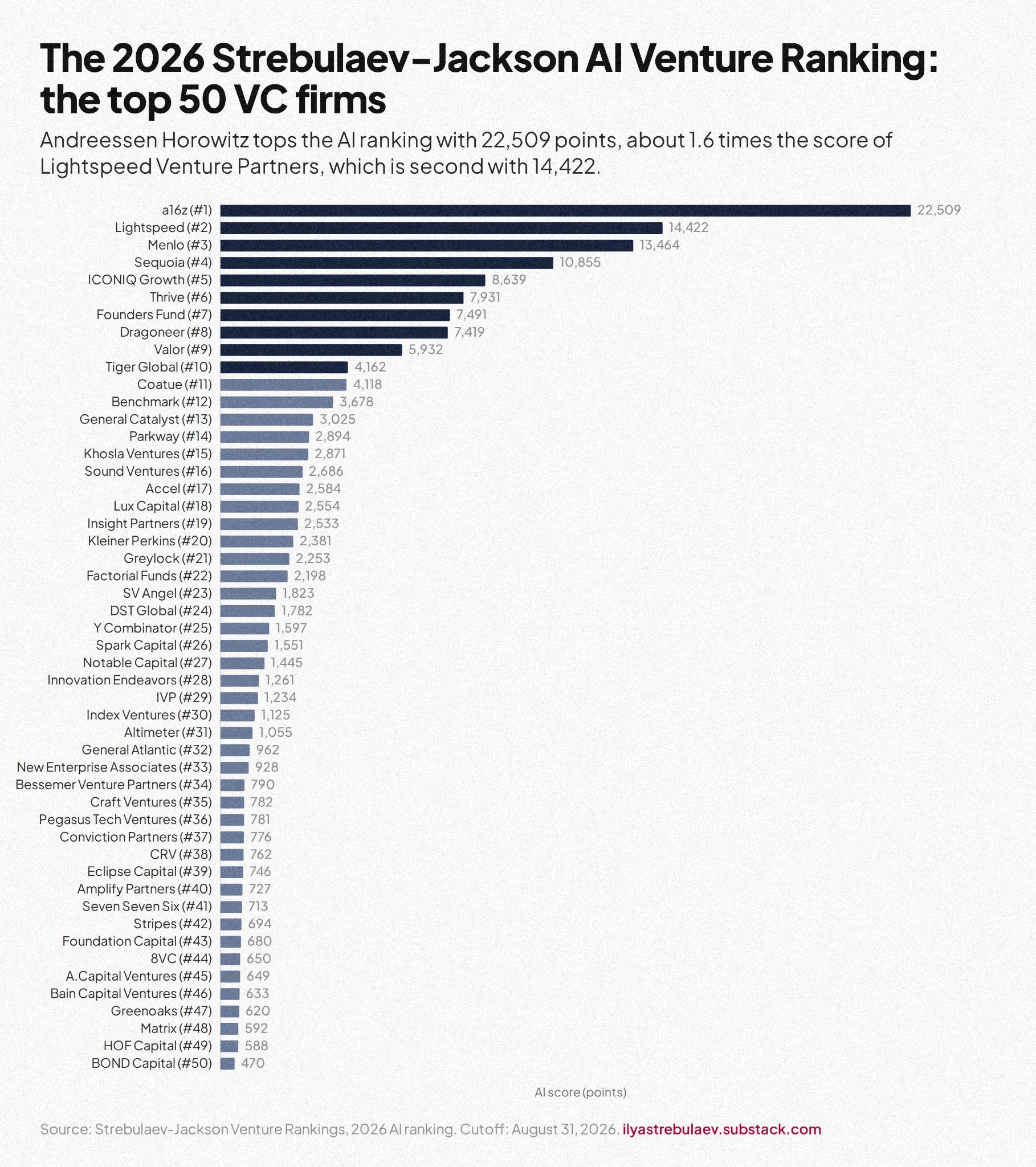
A16z claimed the top spot on the respected ranking of the 50 AI-focused VCs put together by Stanford GSB professor Ilya Strebulaev and Ohio State University professor Blake Jackson. The list is built off data points including valuations, growth rates, dilution, capital distributions, and value-add from the firm.
Lightspeed, Menlo Ventures, Sequoia, and ICONIQ Growth rounded out the top five. While the megafirms also have significant investments outside of AI, firms like Menlo Ventures and Dragoneer scored very well thanks to their heavy concentration in AI and especially in major deals like Anthropic.
Nine Notable Deals
Legora reached a valuation of more than $8 billion while Pigment hit $2 billion in a busy week for outsized European funding rounds. Buzzy neolab Flapping Airplanes hit a $6 billion valuation. Plus, ex-OpenAI executive Bob McGrew secured backing for his manufacturing AI startup.
AI neolab Flapping Airplanes raised $1 billion in Series A funding co-led by Lux Capital and Index Ventures. Other investors include Sequoia Capital, GV, Kleiner Perkins, Valor Equity Partners, Atreides, A*, and Nvidia.
Legal AI startup Legora raised $550 million in Series E funding led by Atreides Management. Other investors include Baron Capital, Capital Group, Fidelity, Glade Brook Capital Partners, JP Morgan, Accel, Benchmark, General Catalyst, ICONIQ, and Salesforce Ventures.
ASI, a startup co-founded by Bob McGrew building an AI system for the military and airlines to manage their assets, raised $325 million in Series C funding led by Spark Capital. Other investors include a16z, Craft Ventures, Meritech Capital, Energy Impact Partners, and Citadel Securities.
AI enterprise-planning startup Pigment raised $250 million in Series E funding led by the Scaleup Europe Fund. Other investors include World Innovation Lab, Greenoaks, ICONIQ, IVP, and Meritech, with an additional planned investment from Nvidia.
Manufacturing AI startup Arda raised $232 million in Series A funding co-led by Altimeter Capital, Khosla Ventures, and Accel. Other investors include Felicis, XYZ Venture Capital, and 8VC.
Otter, the AI note-taker, raised $320 million from General Catalyst’s Customer Value Fund.
Warhound, a startup co-founded by Colossal Bioscience’s Ben Lamm and Anduril’s Palmer Luckey to genetically engineer warfighting dogs, raised $200 million in seed funding from investors like In-Q-Tel, Sequoia Capital, ARK Invest, Franklin Templeton, 8VC, Lux Capital, USIT, Bob Nelsen, Breyer Capital, CAZ Investments, Neogenesis, and Builders VC
Inspired Capital, the early-stage fund founded by Alexa von Tobel and Penny Pritzker, raised $450 million for its Fund IV. Past deals from the firm include Suno, Rho, Deeptune, and MosaicML.
Bison Ventures raised $160 million for its second early-stage fund focused on deals for the “physical world.” Its past investments include Thinking Machines Lab, AI infra startup Zyphra, and robotics company Cobot.
Stories We’re Reading
SpaceX and Tesla reported earnings on back-to-back days this week and beat Wall Street’s expectations, though Tesla’s shares dipped as the firm’s lower-than-expected capex spooked investors looking for more aggressive investment in AI and robotics. But the big action in the Muskiverse was trying to sort out what the inevitable SpaceX-Tesla merger will mean afterMusk publicly endorsed the idea and said both companies had set up special committees to consider a tie-up. In some ways, a merger would simply neaten up the boundaries of the Musk empire: SpaceX already resembles a sci-fi Berkshire Hathaway, and The Wall Street Journal reports that the two companies have been bedfellows for decades, sharing resources and personnel. That said, Musk is technically conflicted out of discussions as the CEO of both firms, and publicly weighing in has already thrown internal talks at both companies into chaos.
Serious issues in the underlying structure of PHP, the scripting language used by more than 70% of websites globally, led to an international security freakout this week. On Wednesday, the PHP Foundation — the organization that manages and supports the language — published a release revealing the discovery of two serious flaws, designated as CVE-2026-109618 and CVE-2026-109619. These holes impact all PHP systems dating back to a version released in 2012, and could allow hackers to gain remote control of any server running PHP that hasn’t installed the fix. The security organizations Calif and Wiz independently discovered the flaws using AI models and reported them to PHP. Shortly after the announcement, cloud providers scrambled to secure their networks. Cloudflare CEO Matthew Prince posted on X Thursday morning that exploitation attempts on Cloudflare’s network rose from thousands in the 10 hours before the disclosure to millions afterward, and Cloudflare said in a blog post that it deployed firewall protections for its customers hours before the disclosure. Research published by Amazon Web Services on Wednesday indicated that at least one hacker had attempted to exploit the bugs on October 17, four days before the vulnerabilities were made public. The PHP Foundation is urging all users who could be affected to update with these patches as soon as possible to avoid hacks. Several government websites running on PHP, including those for Kenya, Finland, France, Germany, and the Netherlands, went preemptively offline Wednesday — and some remained down Thursday morning.
Meta posted $65 billion in Q3 revenues to beat Wall Street’s estimate of $63 billion. Strong ad sales drove the numbers, and investors were initially enthusiastic about the company’s launch of its personal AI assistant Muse and subsequent Muse Wonder model. But after the stock initially jumped, sentiment soured as capex spending rose to $35 billion, free cash flow turned negative, operating margins plummeted, and almost $10 billion was charged for a teen mental health settlement. Meta also announced a new class of non-voting Class C shares that will let the company raise capital for AI spending without diluting CEO Mark Zuckerberg’s voting control. As of Thursday’s close, the stock had fallen 7%.
Polymarket CEO Shayne Coplan has apparently had a rocky ride as Peter Thiel’s Founders Fund tries to mentor the enfant terrible founder. Bloomberg reported that Coplan used company money to pay for living expenses and private-jet flights before Polymarket had generated any revenue — money the investors insisted he repay before they would cut another check. Coplan and his allies pushed back hard against Bloomberg’s characterization of the situation, insisting he proactively accounted for and repaid every dollar as the business grew, and that his total expenses were less than a typical software engineer’s salary. Bloomberg’s piece comes at a poor time for Polymarket, as the former poster child for prediction markets continues to hemorrhage market share to archrival Kalshi. But the story also shows the tightrope VCs must walk to keep startups on the straight and narrow without looking unfriendly to founders.
来源:Newcomer 新闻长文 · newcomer.co