Google 更新隐私政策,Gmail 内容或可用于广告个性化
Google 近期更新了隐私政策,删除了此前关于不使用 Drive、Gmail 或 Photos 内容进行广告个性化的明确限制。新政策配合 2026 年初推出的 Personal Intelligence 功能,允许用户将多应用数据接入 Gemini 及 AI 搜索工具,这可能导致相关数据间接影响广告定位。
Manage your consent preferences
If you are a resident of Colorado, Connecticut, Virginia, Utah, Oregon, Texas, Montana, Delaware, Iowa, Nebraska, New Hampshire, and New Jersey, Tennessee, Minnesota, Maryland, Indiana, Kentucky, or Rhode Island you have the right to opt-out of Targeted Advertising, including our “sale” and/or “sharing” of your Personal Information (“Opt-Out”). We and our third-party business partners use Personal Information in accordance with our Privacy Policy to serve advertising believed to be of interest to you (“Targeted Advertising”). If you are a California resident, you also have the right to limit the use and disclosure of your Sensitive Personal information in particular circumstances. Please note that you may need to Opt-Out on each website, mobile app, browser, and device you use, and if you clear your browser cookies, you may need to repeat this process. However, if you have created an account to log in across several of our websites and/or mobile apps, we will make reasonable efforts to apply your Opt-Out request to each of those websites and apps. ◦ To Opt-Out of Targeted Advertising on this site: Move the “Allow Targeted Advertising" toggle below to the left and press “Confirm My Choices”◦ To Opt-Out of other “sales”, including for list rentals, data co-ops, and to limit the use and disclosure of your Sensitive Personal Information: Please email privacy_administration@condenast.com or call 1-877-241-4999.
Essential
- On
These cookies are necessary for the website to function and cannot be switched off in our systems. They are usually only set in response to actions made by you which amount to a request for services, such as setting your privacy preferences, logging in or filling in forms. You can set your browser to block or alert you about these cookies, but some parts of the site will not then work. These cookies do not store any personally identifiable information.
Performance
- On
These cookies allow us to count visits and traffic sources so we can measure and improve the performance of our site. They help us to know which pages are the most and least popular and see how visitors move around the site. All information these cookies collect is aggregated and therefore anonymous. If you do not allow these cookies we will not know when you have visited our site, and will not be able to monitor its performance.
Audience Measurement
- On
We use audience measurement cookies in order to carry out aggregated traffic measurement and generate performance statistics essential for the proper functioning of the site and the provision of its content (for example to measure performance, to detect navigation problems, to optimization technical performance or ergonomics, to estimate server power needed and to analyse content performance). The use of these cookies is strictly limited to measuring the site's audience. These cookies do not allow the tracking of navigation on other websites and the data collected is not combined or shared with third parties. You can refuse the use of this cookie by switching off the slider to the right.
Functional
- On
This website uses functional cookies and services to remember your preferences and choices, such as language preferences, font sizes, region selections, and customized layouts. They enable this website to offer enhanced and personalized functionalities.
Social Media
- Off
These cookies are set by a range of social media services that we have added to the site to enable you to share our content with your friends and networks. They are capable of tracking your browser across other sites and building up a profile of your interests. This may impact the content and messages you see on other websites you visit. If you do not allow these cookies you may not be able to use or see these sharing tools.
Allow Sale/Targeted Advertising?
- On
We may transfer or share your personal information to third parties for the purposes of targeted advertising. You can learn more about what information is used for this purpose in our privacy notice.
Confirm My Choices Reject All Accept All
Skip to contentArs Technica home
Sections
Story text
Size Width * Links
- Subscribers only
Learn more
Pin to story
Theme
- HyperLight
- Day & Night
- Dark
- System
Sign In
Sign in dialog...
Sign in
An important clarification
Updated Google privacy policy says your Gmail might be used for advertising
Turning on Personal Intelligence gives the company more data for ad targeting.
Ryan Whitwam – Oct 23, 2026 8:19 PM|7
Credit: Aurich Lawson
Credit: Aurich Lawson
Text settings
Story text
Size Width * Links
- Subscribers only
Learn more
Minimize to nav
Using Google’s products and services has always been fundamentally precarious—doing so gives the world’s largest advertising company a lot of juicy personal data. Google has long said it won’t use the sensitive data from products like Gmail, Drive, and Photos for ad personalization, but a change to the company’s privacy policy appears to dismantle that firewall.
On October 16, Google issued an update to its privacy policy, spotted by Android Authority. The ad personalization section used to include a clear limit on data from certain apps. “We don’t show you personalized ads based on your content from Drive, Gmail, or Photos,” the document said. Now, Google has updated it with the following language.
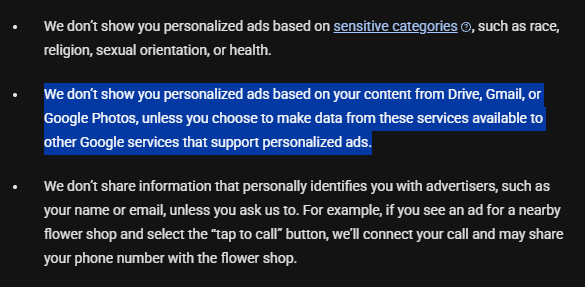
Updated language on when your sensitive data might inform ads.
Credit: Google
Updated language on when your sensitive data might inform ads. Credit: Google
This equivocation opens the door to using data from apps like Gmail and Photos in ads when it’s shared with other Google services, and it just so happens Google has a mechanism for doing that, with Personal Intelligence. The company released Personal Intelligence in early 2026, allowing users to hand data from multiple apps to Google AI products. The idea is that the added context from your existing data will lead to better AI answers, but it’s also proving to be a privacy minefield.
Personal Intelligence connects your data to the Gemini app but also to features like AI Overviews and AI Mode search. While the Gemini app does not currently have ads, you may see sponsored content in AI search tools. Google’s changes to the privacy policy appear to acknowledge that data shared with AI search via Personal Intelligence could, therefore, contribute to ad personalization.
According to Google, this clarification still doesn’t mean ads are “based directly” on your personal data. Here’s the company’s full statement:
“Connecting your apps is entirely opt-in. Ads will continue to be relevant to things like your query, the context of the response and your interests. Ads will not be based directly on your Gmail inbox or Photos library, and as always, sensitive information will not be used to tailor ads.”
Ars Video
How Scientists Respond to Science Deniers
Google’s statement is essentially a roundabout way of confirming that Workspace and Photos data may inform ads. If you interact with AI Mode while Personal Intelligence is enabled, there’s a chance that summaries and insights from your data will inform the answers you get. Because that same data is used for ad targeting, it’s accurate to say that your personal data is an element of ad targeting in AI search. The privacy policy now makes that clear.
A Google spokesperson tells Ars that its privacy clarification does not indicate a change in how it handles your data with respect to its advertising partners. It’s not scanning your entire inbox to enhance your advertising profile, and it’s not giving any of this data to third parties. But if you pipe personal data into an AI search tool, the ads it shows you could be based on that information.
The personalization trap
The core of the problem is that Google wants its products and services to talk to each other. Google sees that wealth of data as a key strength of its AI efforts. Some apps like Gmail are still given protected status in Google’s data handling, but there are now more avenues for that data to get out. The more data you share across Google’s ecosystem, the greater the risk to your privacy.
We’ve seen a similar exception in the way Google uses your AI interactions for model training. While Google says it doesn’t use personal data for AI training, it does use your inputs and the model outputs for that purpose. With Gemini integrated with so many services and connected to them via Personal Intelligence, those outputs may very well contain elements of your personal information. Google has said it tries to filter that content from the user activity controls, therefore keeping it out of training sets. However, it doesn’t promise it will always be successful.
Google is correct that Personal Intelligence is opt-in, but the company uses various prompts and pop-ups to entice users to turn it on without fully explaining the consequences. You may have turned it on without realizing.
If you want to ensure ads never use your personal data in this way, you’ll need to make sure Personal Intelligence is turned off. The easiest way is to access the Gemini settings for Personal Intelligence and disable the connected apps. These settings are also a few levels deep in your main Google account settings under Data & privacy > Personalization settings > Manage Personalized Recommendations in Search Services > Connected Content Apps. From there, you can disable connections to Workspace and Google Photos.
Ryan WhitwamSenior Technology Reporter
Ryan WhitwamSenior Technology Reporter
Ryan Whitwam is a senior technology reporter at Ars Technica, covering the ways Google, AI, and mobile technology continue to change the world. Over his 20-year career, he's written for Android Police, ExtremeTech, Wirecutter, NY Times, and more. He has reviewed more phones than most people will ever own. You can follow him on Bluesky, where you will see photos of his dozens of mechanical keyboards.
Comments
Loading comments...
Most Read
1.Meta shocked by $25B fine after N.M. refused to join multistate settlement
- 2.Disgraced eMudhra drops out of TLS business after using cert private key of 4
- 3.Rocket Report: SpaceX says no thanks to military launches; Spanish rocket nearly ready
- 4.Latest estimate for Starship launches required to support a Moon landing? 22.
- 5.Moderna and Merck say their mRNA cancer vaccine cut death, recurrence by 42%
Customize
Ars Technica has been separating the signal from the noise for over 25 years. With our unique combination of technical savvy and wide-ranging interest in the technological arts and sciences, Ars is the trusted source in a sea of information. After all, you don’t need to know everything, only what’s important.
More from Ars
Contact
Manage Preferences
© 2026 Condé Nast. All rights reserved. Use of and/or registration on any portion of this site constitutes acceptance of our User Agreement and Privacy Policy and Cookie Statement and Ars Technica Addendum and Your California Privacy Rights. Ars Technica may earn compensation on sales from links on this site. Read our affiliate link policy. The material on this site may not be reproduced, distributed, transmitted, cached or otherwise used, except with the prior written permission of Condé Nast. Ad Choices
Sign in dialog...
Sign in
来源:Ars Technica:AI · arstechnica.com