Alphabet Q3 营收近 1280 亿美元但承认 AI 搜索变现更低,股价大跌约 12%
Alphabet 发布 2026 年第三季度财报,实现近 1280 亿美元营收但净利润逊于预期,导致股价大跌约 12%。谷歌在财报中承认 AI 搜索的广告收入低于传统网页搜索,并计划在 AI 领域进一步扩大资本支出和广告投放。
Manage your consent preferences
If you are a resident of Colorado, Connecticut, Virginia, Utah, Oregon, Texas, Montana, Delaware, Iowa, Nebraska, New Hampshire, and New Jersey, Tennessee, Minnesota, Maryland, Indiana, Kentucky, or Rhode Island you have the right to opt-out of Targeted Advertising, including our “sale” and/or “sharing” of your Personal Information (“Opt-Out”). We and our third-party business partners use Personal Information in accordance with our Privacy Policy to serve advertising believed to be of interest to you (“Targeted Advertising”). If you are a California resident, you also have the right to limit the use and disclosure of your Sensitive Personal information in particular circumstances. Please note that you may need to Opt-Out on each website, mobile app, browser, and device you use, and if you clear your browser cookies, you may need to repeat this process. However, if you have created an account to log in across several of our websites and/or mobile apps, we will make reasonable efforts to apply your Opt-Out request to each of those websites and apps. ◦ To Opt-Out of Targeted Advertising on this site: Move the “Allow Targeted Advertising" toggle below to the left and press “Confirm My Choices”◦ To Opt-Out of other “sales”, including for list rentals, data co-ops, and to limit the use and disclosure of your Sensitive Personal Information: Please email privacy_administration@condenast.com or call 1-877-241-4999.
Essential
- On
These cookies are necessary for the website to function and cannot be switched off in our systems. They are usually only set in response to actions made by you which amount to a request for services, such as setting your privacy preferences, logging in or filling in forms. You can set your browser to block or alert you about these cookies, but some parts of the site will not then work. These cookies do not store any personally identifiable information.
Performance
- On
These cookies allow us to count visits and traffic sources so we can measure and improve the performance of our site. They help us to know which pages are the most and least popular and see how visitors move around the site. All information these cookies collect is aggregated and therefore anonymous. If you do not allow these cookies we will not know when you have visited our site, and will not be able to monitor its performance.
Audience Measurement
- On
We use audience measurement cookies in order to carry out aggregated traffic measurement and generate performance statistics essential for the proper functioning of the site and the provision of its content (for example to measure performance, to detect navigation problems, to optimization technical performance or ergonomics, to estimate server power needed and to analyse content performance). The use of these cookies is strictly limited to measuring the site's audience. These cookies do not allow the tracking of navigation on other websites and the data collected is not combined or shared with third parties. You can refuse the use of this cookie by switching off the slider to the right.
Functional
- On
This website uses functional cookies and services to remember your preferences and choices, such as language preferences, font sizes, region selections, and customized layouts. They enable this website to offer enhanced and personalized functionalities.
Social Media
- Off
These cookies are set by a range of social media services that we have added to the site to enable you to share our content with your friends and networks. They are capable of tracking your browser across other sites and building up a profile of your interests. This may impact the content and messages you see on other websites you visit. If you do not allow these cookies you may not be able to use or see these sharing tools.
Allow Sale/Targeted Advertising?
- On
We may transfer or share your personal information to third parties for the purposes of targeted advertising. You can learn more about what information is used for this purpose in our privacy notice.
Confirm My Choices Reject All Accept All
Skip to contentArs Technica home
Sections
Story text
Size Width * Links
- Subscribers only
Learn more
Pin to story
Theme
- HyperLight
- Day & Night
- Dark
- System
Sign In
Sign in dialog...
Sign in
The AI obsession
Google admits AI search makes less money, but it’s fixing that with more ads
Google’s negative cash flow balloons to -$9.06 billion, and stock price tumbles following Q3 earnings.
Ryan Whitwam – Oct 29, 2026 4:24 PM|23
Credit: Ryan Whitwam
Credit: Ryan Whitwam
Text settings
Story text
Size Width * Links
- Subscribers only
Learn more
Minimize to nav
Google parent Alphabet reported its Q3 financial results on Wednesday afternoon, showing a healthy rise in revenue for the months of July to September. But the company’s stock price has taken a beating, marking one of the largest post-earnings drops in its history. It comes down to several troubling aspects of the new report, including an admission by the company that AI search isn’t earning as much as organic search, and despite that, Google expects to spend even more on AI next year.
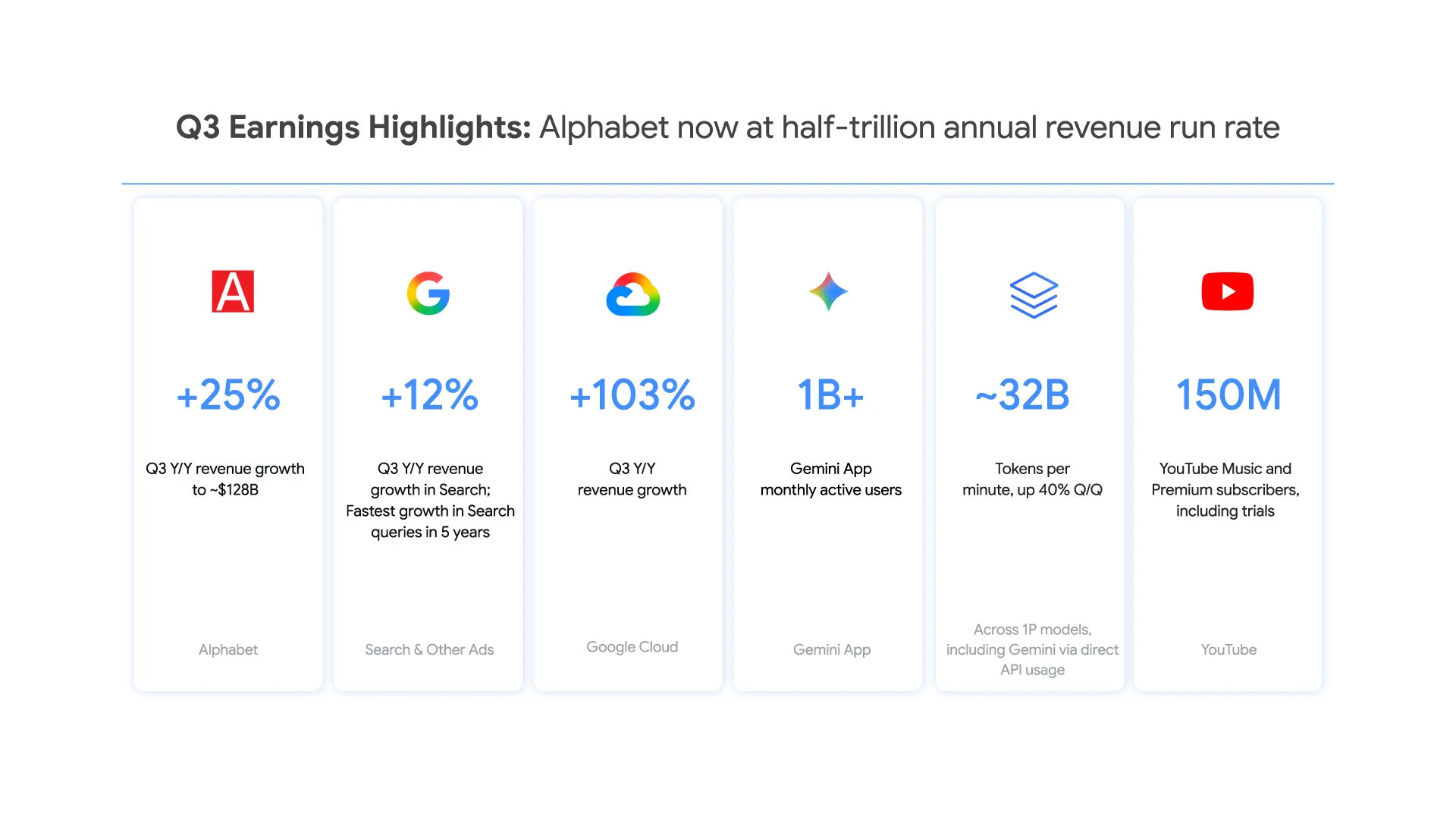
The company took in almost $128 billion in Q3 2026, earning more than $26 billion in net income. These may sound like good numbers, but financial markets are not impressed. While revenue is up 25 percent versus last year, net income is almost $9 billion lower. As of this story’s publication, the stock price is down almost 12 percent, and it was down about 13 percent earlier in the day.
While revenue was up 25 percent year over year, analysts expected more. Google reported earnings per share of $2.12, but the consensus projection ahead of Wednesday was $3.02. Google’s Cloud products actually beat expectations, crossing $30 billion in revenue. That’s about a billion more than analyst guesses.
Google is still making a huge amount of money, but there are several troubling trends emerging. The last few years at the company have been all about AI, with generative technology appearing in products from Gmail to Android. Most notably, Google is shifting to an AI search platform powered by Gemini models.
During the earnings call, Chief Business Officer Philipp Schindler discussed the company’s search volume. This is one of the key metrics by which Google tracks its own performance. In the last quarter, Google saw search grow by 12 percent versus last year. Good for the company, right? Except that’s a much slower rate than previous quarters. Growth in Q2 was 17 percent, and Q1 saw 19 percent growth over 2025. Search revenue was also flat in Q3.
Ars Video
How The Callisto Protocol's Team Designed Its Terrifying, Immersive Audio
So that’s the first problem, likely driven by more consumers using AI chatbots to find answers. The other issue is that Google’s take on AI search isn’t pulling in revenue like standard web search yet. According to Schindler, each AI Mode query earns less revenue compared to a similar web search—there are fewer ads, and they cost less to run.
While Schindler suggested AI mode revenue was set to increase, he was also careful to control expectations. Advertisers may need time, he said, to understand the value in AI search ads. The company’s research reportedly shows that users find these ads more relevant and helpful than the ones they see in traditional search.
As part of the financial disclosure, Google announced an expansion of ads in AI Mode. If you do decide to dip into Google’s search chatbot, you’ll probably see more contextual advertising. These ads will begin appearing in more international markets soon. In the US, where AI Mode ads were already becoming commonplace, Google will implement multi-turn ads. That means the sponsored links will change continuously as you engage in a back-and-forth with the robot. CEO Sundar Pichai noted that these complex interactions are becoming more common as Google pushes more users toward AI Mode.
Stepping on the gas
Google is not slowing down—it’s only going to accelerate the shift toward more AI. Like last quarter, Google reported negative cash flow in Q3. The loss actually increased from -$5.8 billion to -$9.06 billion, a situation that is directly attributable to Google’s runaway AI spending. Google had capital expenditures of $51.4 billion in Q3 and says it still expects total 2026 spending to be between $195 billion and $205 billion. In 2027, Google is targeting more than $300 billion of AI investment.
Credit: Google
Credit: Google
To support this continued spending, Google points to its cloud revenue more than doubling over the past year. It’s easy to see why the company is so keen to keep expanding in AI based on that. The company’s AI compute infrastructure doesn’t just power Gemini. Countless AI startups pay to run models on Google’s infrastructure. But even the larger AI firms are using venture cash to do it, and if that funding were to dry up, Google’s cloud revenues could go with it.
While Google’s investments ensure it still turns a profit, the trend of spending more than it earns on products and services (that negative cash flow) could come back to bite it. Search growth is declining, and Google is placing all its eggs in the AI basket. If spending on cloud services in the industry drops or search growth stalls, the company could be looking at a lot more red in its future.
Ryan WhitwamSenior Technology Reporter
Ryan WhitwamSenior Technology Reporter
Ryan Whitwam is a senior technology reporter at Ars Technica, covering the ways Google, AI, and mobile technology continue to change the world. Over his 20-year career, he's written for Android Police, ExtremeTech, Wirecutter, NY Times, and more. He has reviewed more phones than most people will ever own. You can follow him on Bluesky, where you will see photos of his dozens of mechanical keyboards.
Comments
Loading comments...
Most Read
1.China's top-secret spaceplane can't hide in low-Earth orbit
- 2.Highway thieves are spoofing GPS to steal millions in data center-bound cargo
- 3.Code-execution flaw in UEFI firmware affects most servers on planet Earth
- 4.Touchscreen MacBook Pro hands-on: OLED looks great on a Mac
- 5.Apple announces touchscreen MacBook Pro with OLED display
Customize
Ars Technica has been separating the signal from the noise for over 25 years. With our unique combination of technical savvy and wide-ranging interest in the technological arts and sciences, Ars is the trusted source in a sea of information. After all, you don’t need to know everything, only what’s important.
More from Ars
Contact
Manage Preferences
© 2026 Condé Nast. All rights reserved. Use of and/or registration on any portion of this site constitutes acceptance of our User Agreement and Privacy Policy and Cookie Statement and Ars Technica Addendum and Your California Privacy Rights. Ars Technica may earn compensation on sales from links on this site. Read our affiliate link policy. The material on this site may not be reproduced, distributed, transmitted, cached or otherwise used, except with the prior written permission of Condé Nast. Ad Choices
Sign in dialog...
Sign in
来源:Ars Technica:AI · arstechnica.com