Vesuvius Challenge 社区授予 PHerc. 306B 卷轴 5 万美元首字母奖
Writing seen in PHerc. 306B, for the first time in 2000 years
Vesuvius Challenge 社区宣布向 Liam Warner 和 Nicola Bodill 颁发 5 万美元首字母奖,他们在赫库兰尼姆卷轴 PHerc. 306B 中成功利用机器学习检测到墨迹并恢复出可读文本。
PHerc. 306 was buried by the eruption of Mount Vesuvius in AD79. Since being excavated in the 1750s then micro-CT scanned last year, no-one had read what was written in it. Now, after reviewing a massive 25 submissions on this scroll from the Vesuvius Challenge community, we are finally able to award a $50K First Letters Prize on PHerc. 306B. This one was a challenging one!
Congratulations to Liam Warner & Nicola Bodill for their work revealing ink and recovering readable text from this scroll!
PHerc. 306 is a scroll broken into two parts, which we are referring to as PHerc. 306A and PHerc. 306B. Previously, we had no information about which portion corresponded to the upper or lower section of the original scroll. Thanks to the identification of ink and based on the orientation of the script, we can now say that PHerc. 306B corresponds to the upper section of the scroll, while the smaller remaining portion, PHerc. 306A, is the lower part. Now that ink has been identified in PHerc. 306B, this other portion has become all the more valuable to scan and virtually unroll.
This is the carbonized roll of PHerc. 306B as it looks today. It lives at the Biblioteca Nazionale di Napoli, around 10km from where it was originally excavated at the Villa dei Papiri in Herculaneum:
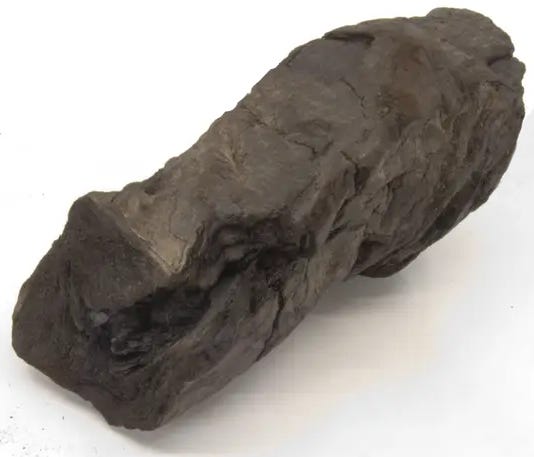
The awarding process proved unusually challenging. We received multiple submissions identifying the exact same area of PHerc. 306B, with several coming remarkably close to the prize requirements. Our criteria set a target of 10 readable characters within a 4 cm² area. Several submissions fell just short, recovering sequences of 7, 8, or even 9 characters.
We would like to acknowledge the contestants who worked on this same segment and came so close to reaching the target before Liam and Nicola’s successful submission: The Gold Panners, Grilli Security Research Team, Matteo Bulloni, Clovis Hublin, TAUIL-Abd-Elilah, Ben Kyles and Colleagues, Les Copronautes, and Doom Scrollers. A huge thank you to everyone for their outstanding work and perseverance!
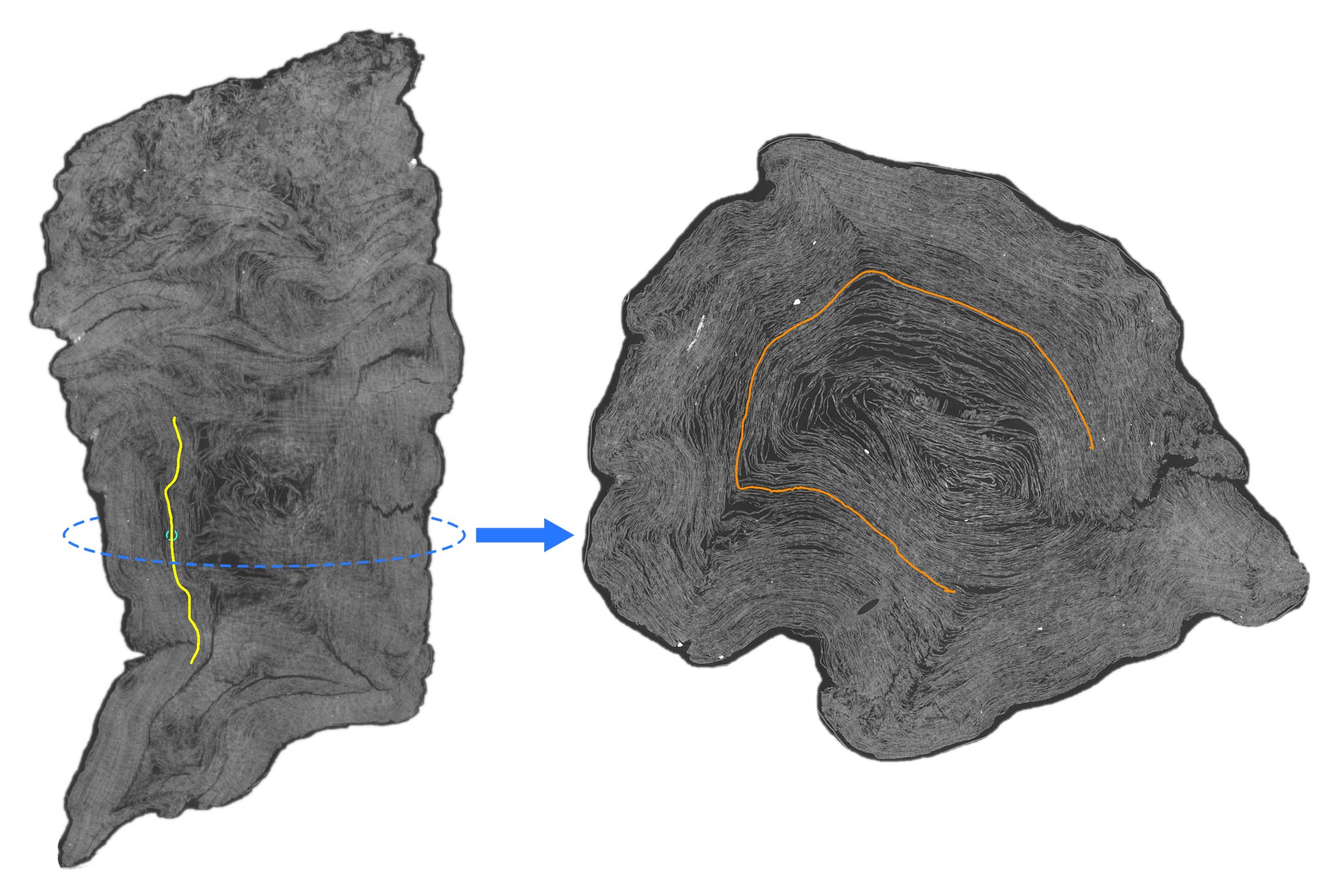
The next images show perpendicular cross-sections from our micro-CT scans of the scroll, taken by the Vesuvius Challenge team at the ESRF in Grenoble. One cuts across the scroll, the other along its length. The sheet of papyrus that Liam & Nicola virtually isolated and read is highlighted in both images, deep within the tight windings of the scroll. These show just how badly distorted and compressed the scroll is – this is typical of the Herculaneum papyri, which were subject to extreme temperatures during the eruption, before being buried in the ruins of the villa.
The sequence τοδιαυτο had been identified in multiple submissions for almost a month. However, what followed remained too faint and uncertain to allow for a consensus among the papyrology team. Several readings were plausible. In particular, the traces immediately following τοδιαυτο were interpreted as either a mu or a nu.
In the image submitted by Liam and Nicola, however, a subtle but significant improvement in readability made all the difference. For the first time, the papyrology team agreed on the reading of αι.
This is particularly interesting from a palaeographical perspective. In majuscule scripts, Μ, Ν, and ΑΙ can often look remarkably similar, and confusion between these letter forms was common even in antiquity, during the copying of manuscripts.
The image below leaves little room for doubt: what had previously been an uncertain sequence can now be read with much greater confidence.
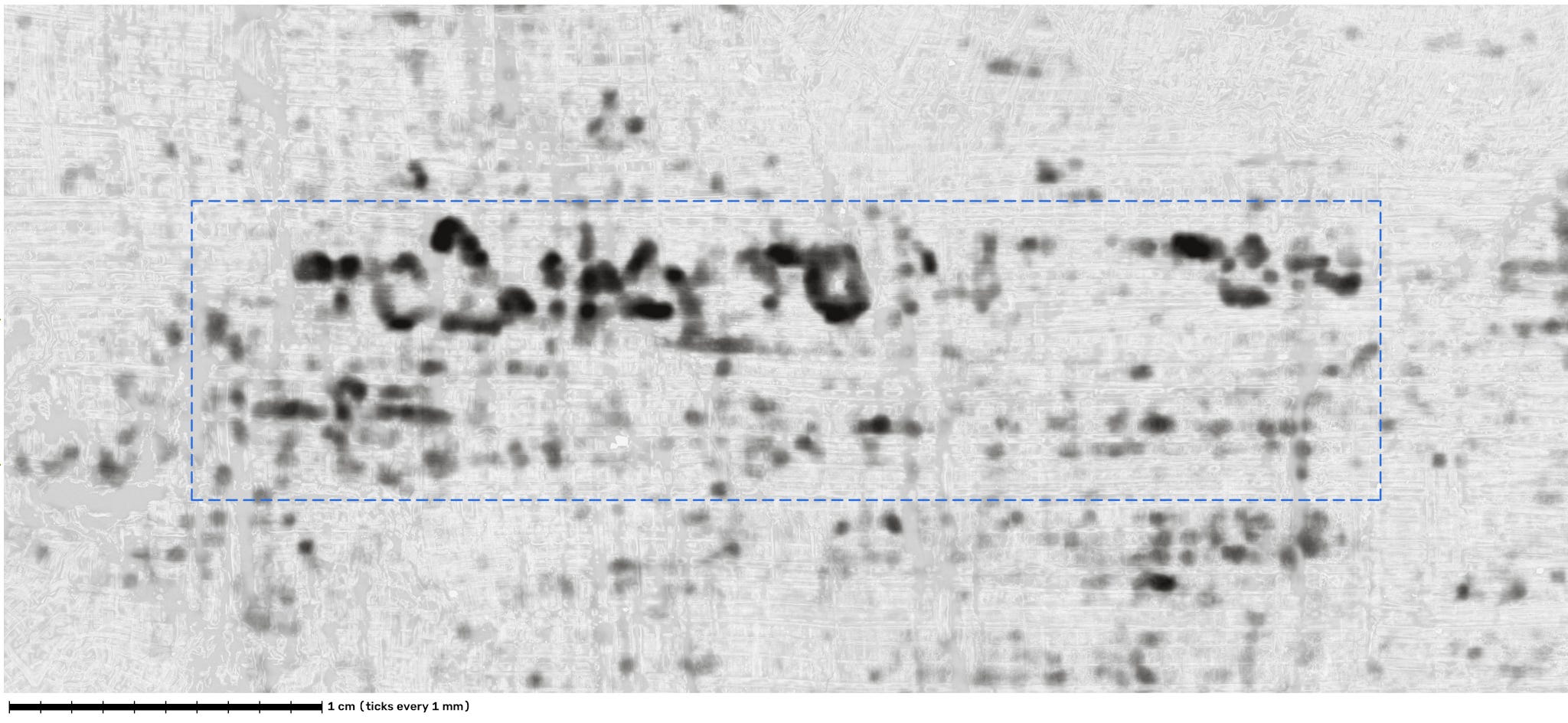
In the video below, the second alpha is compared with the first. The decisive feature is the middle stroke, which rises diagonally from the bottom of the left oblique stroke, just as it does in the first alpha. Liam and Nicola’s submission made this stroke visible for the first time, providing crucial evidence for the reading.
As already noted by Nicola in the submission, the reading τὸ δι᾽ αὑτὸ αἱρ̣ε̣τ̣όν̣ , becomes very plausible. This expression, meaning “that which is in itself desirable,” finds several parallels in philosophical treatises, including works by Aristotle and Sextus Empiricus. A similar expression also occurs in Philodemus’ ethical treatise On Anger. While discussing the bad habit of desiring punishment as a form of enjoyment, Philodemus refers to the “folly of those who think it the greatest good and who turn to it as to a thing in itself worthy of pursuing” (ὡϲ εἰϲ δι' αὑτὸ αἱρετόν) [transl. by D. Armstrong and M. McOsker]. In an Epicurean context, τὸ δι᾽ αὐτὸ αἱρετόν should only refer to good and pleasure.
In their own words…
I am Liam Warner, from northern England. I’m a freelance software engineer/consultant that has worked in areas such as video games, healthcare, and broadcasting technology. Machine learning has always been one of the most interesting challenges in software to me, and I think it represents a great example of creative problem solving and needing novel approaches. I’m a big fan of history generally, and upon finding out about the Vesuvius Project, decided I’d like to contribute. I had planned to just contribute maybe a few optimisations and bug fixes, but with a spare RTX 4090 not doing much I thought I’d see what ink detection looked like. Luckily I managed to strike gold, and with the tireless efforts of Nicola, we were able to slowly improve the quality of our segment, detection model, and reading. A big thanks to Nicola, the support given by the VC staff, and the giants of the VC community we were building on top of.
I am Nicola Bodill from Australia. I have a BA in Latin and Ancient Greek, and am a current MA student at the University of Sydney, working on a critical edition of a 2000-year-old Gandharan Buddhist birch-bark manuscript. Unsurprisingly, I have a lifelong passion for ancient languages, linguistics and literature! The Herculaneum scrolls first captured my imagination when I was 12 or 13 years old, in History class at school. Since 2023 I’ve been poring over the virtually unrolled scrolls, spending hundreds of hours manually creating ink labels to train machine learning models in the hope of incrementally improving the text. I presented a paper on my approach at the 2025 International Congress of Papyrology. Each new letter saved from the ‘innumerabilis annorum series et fuga temporum’ (’innumerable series of years and flight of time’) is precious, so it’s very exciting and meaningful work, if often painstakingly slow. But sometimes there are Eureka moments, and I was thrilled when I read the first letters in this scroll. Many thanks to the Vesuvius Challenge staff and participants who have offered kind words, advice and comradeship. And of course many thanks to Liam, who completely anchored this result.
The segment (i.e. the surface within the 3D scan) was created using VC3D’s GrowPatch tool, on the m7 surface predictions released by the VC team. The seed location for the patch was chosen to lie on a line found by screening windings produced by the publicly-available spiral-fitter; the right-hand end of the patch was corrected by snapping to the m7 surface predictions.
The final ink detection is given by multiplying the outputs of two ink models, meaning a pixel shows as ink only where both agree. One is TRACE v3B, a public model from Jashanjot Singh Gill & Nhat Nam Tran. The other is A-hn, a custom model fine-tuned by Liam & Nicola starting from the v8-in model by Youssef Nader (itself used to discover the first letters in PHerc. 1447). The average of three 600-step runs, each trained half on the PHerc. 1447 labels from Youssef and half on machine labels made by averaging four public models (v8-in, Reader v3 and v2, and TRACE v3B) on other parts of PHerc. 0306B, with an extra loss penalty for marking blank papyrus as ink.
You can download, reproduce, and build on their work:
GitHub: https://github.com/SirProdigle/pherc0306b-first-letters
Data: https://huggingface.co/datasets/Prodigle/pherc0306b-first-letters
After this discovery, there are still 20 more scrolls eligible for our First Letters Prizes – scrolls that we’ve scanned, but that no-one has found enough readable text in yet. It also makes PHerc. 306B a front-runner for the Grand Prize – we’ll award $800,000 for the first team that manages to virtually unwrap and read 70% of an entire scroll with minimal human input. Our community is actively working on these – we’ve already seen submissions on 13 other scrolls (other than PHerc. 306B and Erwin Nieuwlaar’s prize-winning work on PHerc. 0343), though none has yet met the requirements for a prize. Extending these results to give reliable ink detection on 8–9um resolution scans, which are relatively practical and affordable to acquire, will allow us to unlock the rest of the Herculaneum collection.
No posts
来源:Hacker News-首页 · scrollprize.substack.com